


a mile wide and an inch deep
I can still remember sitting in school at age 14 with a GCSE subject options sheet in front of me.
We were being asked to decide which subjects we were going to continue learning, and which we were going to drop. In the end, I decided on Latin, geography and art.
Two years later, the subjects narrowed again. In the UK, you go from studying a broad collection of GCSEs to three or four A-level subjects. University usually asks you to specialise further. Then you enter work, pick a profession, join a department and, eventually, become known for a particular corner of it.
By the time you are 30, you might have spent half your life narrowing down.
And this comes with a good reason. Modern economies are built on the divisions of labour. Professional services firms in particular have spent decades dividing complicated problems between people who know increasingly large amounts about increasingly small areas.
Take law firms, for instance. They won’t just hire a lawyer; they hire an employment lawyer, a restructuring lawyer, a tax lawyer, or a competition lawyer. We see the same pattern repeating across industries like consulting, finance, marketing, and pharmaceuticals.
Now, AI offers instant access to general knowledge, shifting value toward professionals who can connect disparate disciplines.
The useful shape for a lawyer over the next decade could be the T: deep in one area, increasingly wide everywhere else.
Funnel Vision
Specialisation has long served as the default path to value in professional services.
I remember reading about the economist Adam Smith when I studied economics at A-Level. He wrote about the division of labour in The Wealth of Nations in 1776. His pin factory is still the basic logic behind large professional organisations today - to break complicated work into narrower parts and let people become very good at their bit.
As law became more complicated, it became increasingly unrealistic for one lawyer to know everything. Firms built departments, those departments built subgroups and the lawyers inside them accumulated knowledge that became increasingly difficult for outsiders to replicate.
In turn, their knowledge becomes worth a premium, as few other lawyers have their intel and market know-how to act in the same way.
Jack of One Trade
While generative tools can synthesise information into clear answers, clients pay for contextual problem-solving.
A deal has started to go wrong. A regulator has asked a question. Two founders who used to get along suddenly don't. Or maybe a company wants to enter a market where the rules are unclear.
The lawyer is constantly being asked “what shall we do”.
The answer depends heavily on contextual nuance- conversations, relationships, and accumulated experience that cannot be reduced to a prompt.
The deeper your understanding of the client, the industry and the type of problem in front of you, the better placed you are to decide what matters.
Master of Some
The more exciting part of the T is probably the top.
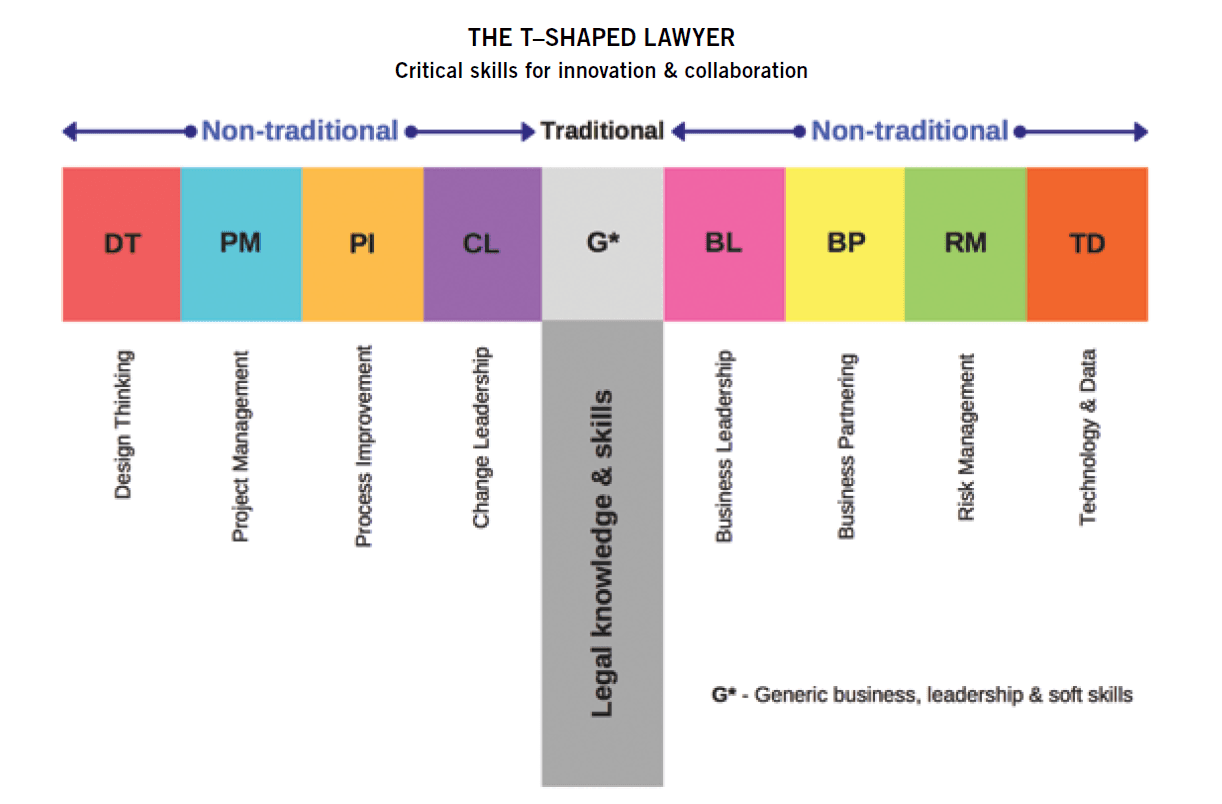
Amani Smathers introduced the idea of the T-shaped lawyer to the legal profession more than a decade ago. Her model combined deep legal expertise with enough understanding of areas such as technology, business, analytics and data to work more effectively across disciplines.
AI makes that horizontal bar much easier to extend.
Take psychology. Lawyers deal with people who are stressed, ambitious, angry, defensive or trying to save face. A technically brilliant answer can fall apart because nobody thought seriously about the person who had to receive it.
Take project management. If AI allows a lawyer to handle more matters at once, the ability to keep track of those matters becomes more important. Drafting might become faster while prioritisation, communication, delegation and context switching become the constraint.
Technology is an obvious one. You probably do not need to learn how to train a frontier model, although understanding the systems your clients use and the way information moves through them is quickly becoming part of understanding the business itself.
Then there is negotiation, data, commercial judgement, design and sales.
I think sales in particular gets overlooked by lawyers. Being very good at something is economically different from the market knowing you are very good at it. As producing competent knowledge work becomes easier, reputation and trust could carry more weight.
T-ing off
For junior lawyers in particular, career planning is often framed around finding the right specialism.
Perhaps a better question is “how are you T-ing off”
Start with the stem.
What is the area in which you want people to eventually associate your name with expertise? You do not need to know the answer immediately, and early careers should contain room for experimentation, but genuine expertise requires accumulated experience. At some point, you need to keep digging.
Then look horizontally.
Rate yourself across the skills surrounding your legal expertise: technology, psychology, negotiation, project management, data, commercial understanding, communication and business development.
The aim isn't to become an expert in all of them. It is to notice where the gaps are, and then use the extraordinary educational tool sitting on your laptop to start filling some of them.
The shape will look different for everyone. Someone working on technology transactions will probably build a different crossbar from an employment lawyer. Someone who wants to become a partner will need a different one from someone who wants to build legal products.
And the shape should keep changing.
We have spent most of our education being pushed through a funnel, dropping subjects as we go until we arrive at something we can finally call our specialism.
For the first time, AI makes it cheap to start picking some of them back up.
Keep digging down.
(But start looking sideways too.)
Further reading that I’ve enjoyed
David Epstein — Range: Why Generalists Triumph in a Specialized World. Epstein's argument for breadth, experimentation and transferring insights between domains is a useful counterweight to the conventional “specialise early” model.
Alyson Carrel — Legal Intelligence Through Artificial Intelligence Requires Emotional Intelligence. Explores the evolution of the T-shaped lawyer and argues for a broader competency model as AI changes legal work.
